My So-Called Yoga Life

The best and most beautiful things in the world cannot be seen or even touched- they must be felt with the heart. ~ Helen Keller
My So-Called Yoga Life
  • Home
  • About
  • Contact
  • Tag: yogaphilosophy

    • Yoga & The Shat Kriyas

      Posted at 1:50 am by Lisa K, on December 4, 2017

      Yoga as it has been popularized in western culture is primarily characterized by asana or the practice of physical postures. There are many people who become more involved in the practice by learning about yoga philosophy and the eight limbs of Ashtanga Yoga. From pranayama (breathing practices) to Dhyana (meditation), people have started to become more aware of the deeper meanings and related rituals and practices involved in yoga. When we think about the second limb, the Niyama, the first is sauca. Sauca refers to the purification of the body both internally and externally. As Chip Hartranft comments in his version of ‘The Yoga Sutra of Patanjali’, sauca extends both to the corporeal sphere of proper diet and cleanliness, on the one hand, and for “mental purity”. This leaves much for us to do as yoga practitioners both physically and within our minds to become closer to the blissful state of Samadhi, the eighth and final limb of Yoga.

      What are the Shat Kriyas?

      According to another prominent yogic text, the Hatha Pradipika, these are internal bodily cleansing processes. I am sharing these with you because I have personally practiced them, learning them from my first yoga training teacher, Paul Dallaghan, on my first 1 month intensive in Thailand. We do pranayama and asana to purify the body as well. The primary series of Ashtanga yoga or the Yoga Chikitsa is meant to purify and detoxify the body. The shat kriya should be practiced in conjunction with the asana and pranayama practice to obtain more effective body purification. When I begin to describe these kriyas, I know some may sound rather extreme, but like anything, with practice they will become easy and routine if you wish to do them.

      The Shat Kriyas:
      1. Neti- jala and sutra – nasal cleansing
      2. Nauli – abdominal organ cleaning
      3. Vaman (dhauti) – stomach cleaning
      4. Kapalabhati– respiratory tract cleansing
      5. Basti– colon cleansing
      6. Tratak– clearing the mind through candle staring

      1. Jala Neti

      Jala neti is nasal irrigation and has gained much recognition in western cultures as of late. Doctors even prescribe for their patients to use a nasal irrigation bottle for allergies to post nasal drip conditions. My husband has a deviated septum and a permanent opening in his upper nasal cavity for which he has been recommended to do this activity. Jala neti uses a small tea pot like container with a salt/water solution poured through one nostril and let to flow out of the other nostril. There is a particular technique so that the water drains properly. It is to cleanse the nasal passageway and I do this technique on a daily basis. It is important, especially if pranayama or even asana are practiced so that deep breathing is completed with a clean airway.
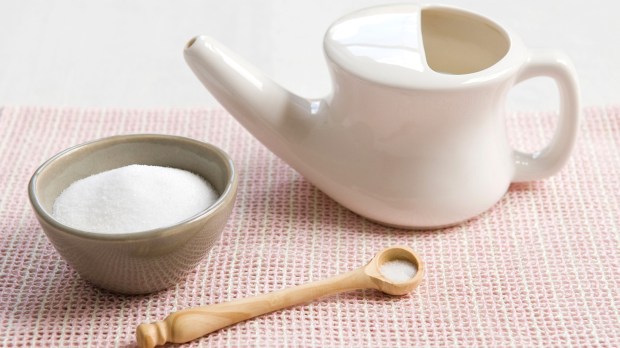
      Neti pot with salt and spoon

      Photo: Neti pot and salt

      Sutra Neti

      Sutra neti is something which I have practiced, but it has not remained a daily practice for me because I find it invasive. It is meant to more intricately clean the nasal passageway and I understand it’s purpose, but it is not comfortable for me to do regularly. It uses a rubber tubing which is slowly fed through one nostril until it comes into the back of the throat. This end is retrieved there and it is slowly pulled back and forth from the nostril to the mouth to clean the passage. At first, I gagged on the cord, but with practice it can be accomplished more easily than one might imagine. However, I do agree that it is not pleasant to do. Afterwards though, I do feel more of an awareness of this area of my body and like flossing, it becomes like necessary evil.
      I do this one maybe twice a year, not very often. I do floss daily though, lol. After being a dental hygienist for many years, I have a healthy flossing habit.

      IMG_2639

      Photo: A sutra neti cord

      2. Nauli

      The starting point for this practice is to do uddiyana bandha. On an empty stomach, preferably in the morning, a deep breath is taken in. It is then exhaled and you bend over and place the hands on the thighs close to the hips. Pressing down on this place and without drawing any air in, the abdominal area is drawn up and under the ribcage. It creates heat in the body and helps to identify where the power and strength of this bandha comes from for the Ashtanga asana practice. After this is a place you can find, nauli is practiced. First the rectus abdominus muscle is isolated. This is not an easy feat. With continued practice it can be pulled forward and then nauli is done when it is rhythmically moved from right to left and then in the opposite direction. I am not a master of this process, but I do practice it. I find that on days where my motivation and energy are low, it is most beneficial because it creates an energy and focus of its own that helps to invigorate my desire to practice. I usually do 5 rounds of uddiyana bandha and then 5 rounds of nauli when I feel this way and I’m good to go!

      IMG_2637

      IMG_2637

      Video- a small clip of the current state of my nauli practice

      3. Vaman (Dhauti)

      This kriya was most disturbing to me. I really dislike the feeling of vomiting and that is basically what you do in this practice. The purpose is to cleanse the stomach. A large bottle of water, lukewarm 1 litre to 2 tsp of salt, is drank quickly. The right hand is then used to induce vomiting so that the water is thrown out. I did this practice 1x week after returning from Thailand but have since lost its practice because I find it so disturbing. I dislike the feeling of vomiting and do not feel that it is necessary to subject myself to this practice regularly. Perhaps I should, but I do not. Neti should be performed following vaman to clear the passageways of the remaining water which comes up from the stomach.  I have dhauti in brackets next to my subtitle because vaman is actually one form of the stomach cleaning practices of which there are more.  They are increasingly invasive, as I recall, one involves swallowing a large length of cloth.  I will not discuss them further here as I have not done these myself.

      4. Kapalabhati

      If you have ever been to a moksha yoga class, you have probably experienced this pranayama. It is completed by taking a deep inhale and then doing shallow, audible exhales very quickly through the nose. It is to help remove any leftover water from jala neti and vaman and should be practiced after these. Kapalabhati is also an internal heat generating pranayama and caution should be taken in its practice. Any practice which involves extra internal heating should be under the guidance of an experienced teacher. In fact, all of these kriyas should be practiced first by the instruction of an experienced teacher. I found that in my constitution, some of them did not suit me well. I wish to write a post about aryurvedic body constitution soon. I am strongly pitta which is already a heat generating constitution and so this practice is to be completed in a limited way for me.

      5. Basti

      Ok, this colon cleansing practice is more than I am willing to do. Luckily on my stay in Thailand, there was a colonic machine available so it was a bit more accessible for me. Cleaning the colon has several practices which I will not discuss here because I have not done them personally. I have only done the colonic method where I helped guide a lubricated tube into the anus and then water was pumped into the colon and then later ejected. The idea of these practices is again to purify and cleanse the colon. I do understand the purpose and need for these practices because it is possible nowadays more than ever for food stuffs to become lodged within due to the preservatives and simulated products we have available in this day and age. It is important to have a healthy and clean colon for regular bowel movements and toxin removal, especially for the practice of yoga asana!

      6. Tratak

      This is a practice that also helps the practitioner become closer to Dharana or concentration which is the 6th limb of yoga. Dharana means to fix the mind’s gaze or consciousness onto a single point. Tratak is when a candle flame is lit in the dark and placed at eye level about 3 feet away. The practitioner should be seated in a comfortable position such as sukhasana (cross-legged) or padmasana (lotus). The flame is stared upon until the eyes become dry and then the practitioner lies down and rests in savasana for 5-10 mins. Tratak is to clear the mind, create focus and bring consciousness within. I do this one about 1 a month and really I could do it much more frequently. It does remind me when I was a kid, my best friend and I would go into the closet and stare at each other in the dim light of a flashlight shining at the opposite wall. We would stare at each other’s faces until we could see nothing except the others eyes. Tratak is a very focusing practice and I enjoy this one. It can be completed daily because it doesn’t take that much time really at all.

      IMG_2640

      Photo: Tratak or candle staring

      So you see, Yoga is such a complex practice and there is so much more involved than just doing poses and breathing. While these aspects on their own are capable of serious transformation, the kriyas are the next step of creating a body and mind which are clear and very sensitive to the stimuli in our complex world. I hope you have found this information interesting and useful. It doesn’t hurt to try some of these practices to see the depth of their healing. I recommend finding a teacher to help you in your practice of the kriyas and yoga asana in general, as it will be most beneficial to you mentally and physiologically. Wishing you the best as always, namaste.

      Love to you,

      Lisa xo

      Share the Love

      • More
      • Share on Tumblr
      • Pocket
      • Click to share on Telegram (Opens in new window) Telegram
      • Click to share on WhatsApp (Opens in new window) WhatsApp
      Like Loading...
      Posted in Life & Yoga, Uncategorized | 8 Comments | Tagged ashtanga, deeperpractice, hathapradipika, kriya, neti, shatkriya, sutra, Yoga, yogaphilosophy
    • The Havan Fire Ceremony

      Posted at 2:41 am by Lisa K, on November 26, 2017

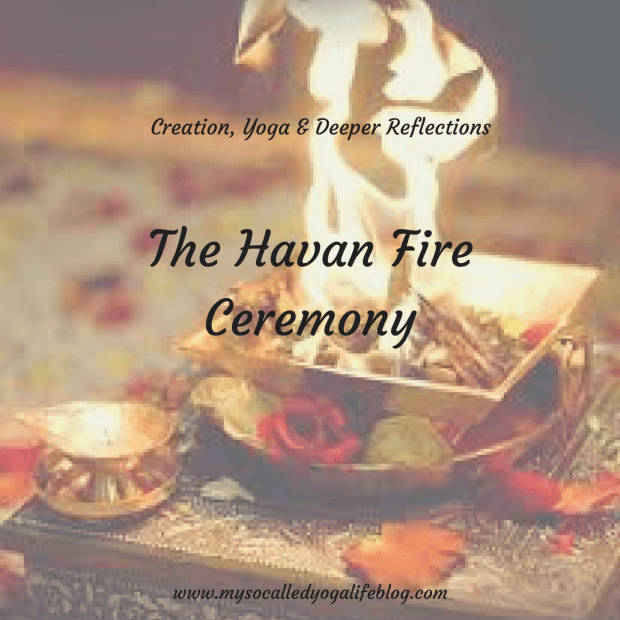
      A few weeks ago, I had the privilege of joining a Havan Fire Ceremony with our current yoga teacher training group at The Yoga Mat. One of my colleagues is part of the Dhyan Foundation which is a spiritual and charitable organization run solely by volunteers to spread awareness and knowledge of the path of yoga. Teaching many authentic practices involved with yoga, the Havan is a ceremony dedicated to aid the positive forces of creation. As human beings we commence in a Havan for the peace and prosperity of our home and creation as a whole. The ritual has been recorded and it’s practice is sustained in ancient Vedic texts which are important resources involved in forming our understandings of yoga today.

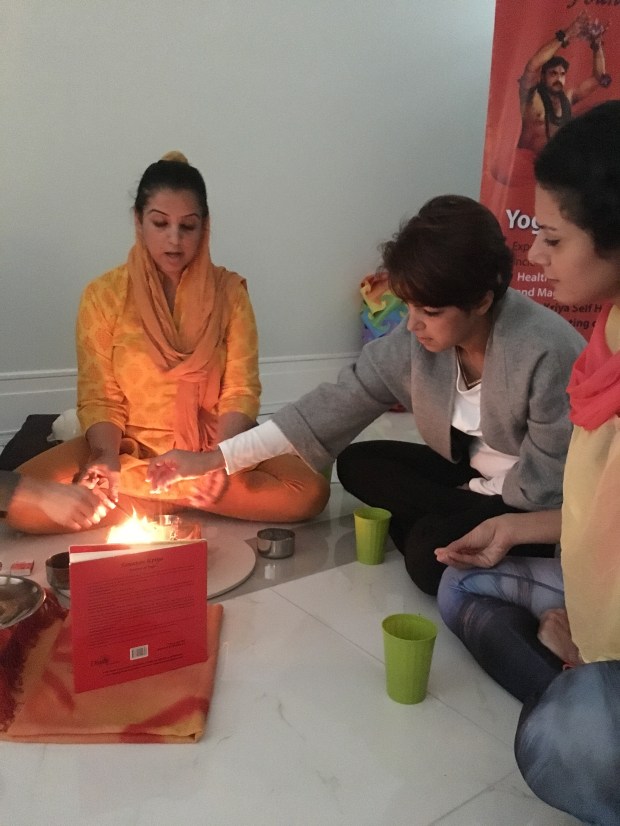
      The Havan is a ritual where all aspects of the ceremony are performed and prepared for with intention. The fire is lit and Sanskrit chants are spoken to create the proper atmosphere for the spiritual intention. There is ghee or clarified butter used as an offering and it crackles the fire during chanting. It is at this time that fragrant medicinal herbs are spread into the fire. These are prepared specially at home prior to the ceremony for the purpose of offering. There is a conch shell blown as a horn before and after the ceremony. The hands are washed to purify before we begin. We sit with crossed legs and palms turned up to accept and allow the positive energy to flow freely around and through the group. The whole process serves as a meditation and a focus on creating a sacred and inclusive space for those involved to really connect with the intention but more importantly, with each other. As I sat and listened to our guide, Chaavi, chant, I could hear the Gayatri Mantra and pieces of other mantra which I have become familiar with through my own path of yoga. The Gayatri is a powerful mantra and is said to mean “May the divine light of the Supreme Being illuminate our intellect, to lead us along a path of righteousness”. It is a powerful mantra which is said to purify the chanter and also the listener, by the Rig Veda.

      IMG_3420

      Above: Chaavi performing the Havan for us

      When I went to Thailand to see Paul Dallaghan and Sri OP Tiwari almost eight years ago now, we did this very ceremony every morning before we began our pranayama and asana practice. I remember the ghee being spread over the flames of the fire and the grains being offered by students into the fire during the meditative chants that were performed by Paul and Tiwariji. The feelings I experienced at the end of our Havan back here in Canada with Chaavi were the same. I felt grounded, connected, soft and aware of something greater than each of us- our communal energy, when we ended the ceremony. It felt like we participated in something which drew up energy from within ourselves and from the one place with which we all exist. Such a peaceful and calming feeling overall. An experience which I highly recommend for yoga practitioners and non-yoga practitioners alike. At the end of the ceremony we were offered to place the ashes of the fire onto our third eye, the forehead as it is a way to connect our divine being. Of course I accepted this offering because, who wouldn’t want to experience that?

      My Personal Deeper Reflections on Yoga

      My reflections upon yoga are echoed with each experience I have had over these past 10+ years that I have been learning and practicing. The practices and the meanings are like a catapult for the mind into places of my being which lay in a sort of coma for much of my teenage to early adult life. As a child, I had no barometer for what was socially accepted and did what I felt was right. I painted my shoes. I participated in the science fair. I sang, danced and created art. I even earned a creative arts award on my grade eight graduation. I accomplished much in dance, I was accepted to a prestigious ballet school and won contests for art at local fairs. I followed my light. I did what I felt was right from within. As a teen, I became consumed by acceptance. There were some other disturbances as well. I turned inward, into my shell. I became insecure about socializing and fitting in. I lost connection with my internal knowing. I felt disconnected. I didn’t feel like I fit in with my peers. I had decorated my locker in grade 9 with a collage of cat pictures I liked. When some peers saw the effort I put into it, they thought it was weird. I was ridiculed by my local dance teacher when I came home from dance school. I didn’t want to pursue it because I wanted so much to be home with my family. I missed them and wanted more than anything to be with them than to follow my dream. My teacher couldn’t relate. I felt alone. I lost my connection, I became obsessed with perfection. I thought that if I did what was expected really well, no one would put me down. I could be invisible. If there was nothing to complain about, how could I be a spotlight? As I moved into adulthood, I was able to sort out many of the feelings I had as a teen. I mean, many kids struggle at this hormonal and changing time in life.

      It was Yoga that really helped me heal from my disconnection. It has helped me to reconnect to that inner voice that I had shut down because it didn’t fit in. You see, yoga doesn’t care if you are fitting in with the trend or what is cool. Yoga is there to help you reconnect with what is important, with what really matters in life. I feel more confident in my own skin now that I ever have as an adult. I am rekindling my own fire with that unstoppable energy that guided me as a child to do what is right for my soul, what is right for me. I once again march to the beat of my own drum and don’t care if it’s not the same beat as anyone else. I am me. I am happy to be me. I connect to me. It is a beautiful feeling. When I think about how many years went by where I was a bit lost, I feel bad, but I don’t dwell on what I can’t change. I move forward and let my light guide me where I need to be. It feels wondrous and I think we can all find that place within ourselves. I wish this for every human being on this planet. I dream of the day where we are all Yoga and we are all truly aware that we are ONE ~ Samadhi.

      LOKAH SAMASTAH SUKHINO BHAVANTU

      Means~ May all beings everywhere be happy and free, and may the thoughts, words, and actions of my own life contribute in some way to that happiness and to that freedom for all.

      Best wishes my beautiful readers,

      Love,

      Lisa xo


      Share the Love

      • More
      • Share on Tumblr
      • Pocket
      • Click to share on Telegram (Opens in new window) Telegram
      • Click to share on WhatsApp (Opens in new window) WhatsApp
      Like Loading...
      Posted in Event Reviews, Life & Yoga, Uncategorized | 24 Comments | Tagged energy, Havan, inspiration, knowledge, life, lifestyle, motivation, philosophy, startyoga, vedas, Yoga, yogainspiration, yogalife, yogaphilosophy, yogateacher
    • Sankalpa~ Giving Beautiful Meaning to Every Single Day

      Posted at 2:48 am by Lisa K, on November 12, 2017

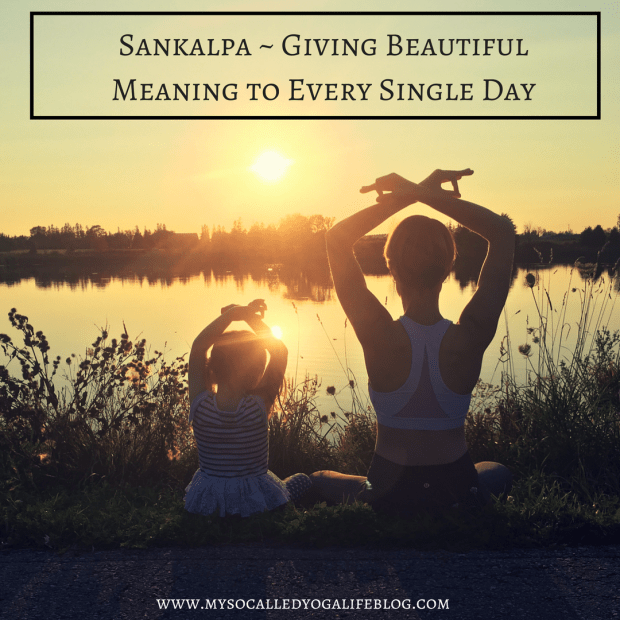
      What is sankalpa?  It is broken down to mean ~ the highest truth of the heart which is followed above all others. It is an intention that you decide to follow that will serve your highest truth or purpose. Sankalpa is referenced in the Rig Veda which is one of the oldest yogic texts that form the foundation of our philosophical understandings of yoga. I have been to many yoga classes where the instructor will invite students to set an intention for the class. May it be to dedicate it to someone or a feeling inside such as “I am joy” or “I am courageous”. The wonderful thing about sankalpa is that it posits that you already are the intention you wish to fulfill. It is just that we must realize and use our mind to focus on bringing out these qualities within ourselves, to connect within. I find this concept to be innately beautiful. Imagine…all the doubts you have about yourself, the unsure thoughts, the potential harmful self-talk you may have from time to time- become non-existent. There is no place for doubt when we already are what we wish to be.  So confidence inspiring, with such conviction and above all so validating of who we are and what we are capable of doing. I am what I am meant to be. I am capable of fulfilling my dharma or my purpose in this life.  There is no question.

      How does Ashtanga Yoga help us to see our Sankalpa?

      Yoga helps us to tune in, to become aware of the thought processes and internal obstacles that make the awareness of our abilities become obscure. We live in a society ridden with self-doubt and unfulfillable ideals. It is like we all want to be something that we think we are not able to be. There must be some impossible task to create dis-ease and woe in our hearts.  Why???? Why do we want to feel inadequate? Why do we buy in to these ideals which are unattainable, therefore causing a sense of incapability?
      It is only when we are challenged that we can truly call on our innate abilities. They will automatically come to the forefront because we need them. It is not easy to commit yourself to doing a physically challenging practice on a daily basis. Ashtanga calls to us to do this. It asks us to be present, to breathe into difficulty, to find ease in what creates uneasiness. Yin and Yang are called to become one. A synchronicity within our internal controls is the savior to our woes. It is part of our creation. We live. We die. We are part of a cycle of life much greater than our individuality that we never ever become disconnected from. It is the fuel, the breath, the momentum of our existence. Sankalpa. Dharma. Life force. These qualities are one and the same. Ashtanga helps to repeatedly identify the strength and perseverance of what lies within so that our Sankalpa may become clear.

      Sankalpa makes me think about my highest truth and why we exist. What is my purpose?

      It’s a difficult thing to contemplate. What is the purpose of existence if we are merely part of a cycle? Why is sankalpa important? I believe it is a question we can only find the answer to in our own way. For me, I have only glimpsed my truth, most notably it has been in some deep conversations with my grandma that I have found some peace and a little bit of insight. I feel that part of my highest truth is to be of service to make the world a better place. I see this in my Grandma. My grandmother is a very strong woman. Among her impressive qualities are enduring love, she gives of herself freely with no expectation. She is compassionate, so giving of all of herself, her thoughts, her love and her life. I connected with her at a very young age. She made me feel strong, appreciated, capable and most of all, loved. I always felt that she would be there for me, even if I faltered or if there was negativity surrounding me. Her care was and is unconditional to this very day in her 85th year of life. She has discussed death and how life is part of this cycle with me from her perspective. When I hear her speak of it, I feel part of her knowing and understanding that it is just part of what it is to be a human being. Now that fact is mere science, but the understanding of it is a much deeper and darker reality that some priming for is a gift. My granny is a beautiful gift of so many things, I am grateful to be among those blessed to be a part of her family and life.
      You see, I view my Sankalpa as an intention with the undertone of service, of giving. The ultimate gift is to give without expectation. This is what may be the sankalpa of my daily life in little bits each day. I can be giving of my heart, to listen, to be thoughtful, to be supportive, to be kind. Like my grandma.  Think about those little intentions that you can do each day to fulfill your own personal Sankalpa – I am courageous. I am joy. I am forgiveness. I am light. I am giving. We are really all of these things already. Do you know that? Find the beauty within you. It is strong.  Share it with others and relish in the happiness that it gives you to make another feel your love. Do it without expectation. Find your Sankalpa and live it each day. How wonderful is it to be able to live your purpose, your highest truth, in little acts each and every day?

      Best Wishes to you all my friends.  May the new week bring many smiles, laughter and love to you💖

      Lisa Michelle xo

      Share the Love

      • More
      • Share on Tumblr
      • Pocket
      • Click to share on Telegram (Opens in new window) Telegram
      • Click to share on WhatsApp (Opens in new window) WhatsApp
      Like Loading...
      Posted in Life & Yoga, Uncategorized | 23 Comments | Tagged communication, energy, happy, inspiration, Livingyoga, motivation, philosophy, vedas, Yoga, yogainspiration, yogalife, yogaphilosophy
    • Recent Posts

      • It’s Not You, It’s Your Nervous System
      • The Quiet Power of Kindness
      • Living in the Moment – Entry Two
      • Living in the Moment
      • Reflections on 2024
    • Categories

      • Uncategorized (66)
        • Mini Yogis (2)
      • Poetry (30)
        • Creative Writing (6)
      • Life & Yoga (13)
      • Yoga Sequences (5)
      • Meditations (3)
      • Event Reviews (2)
      • Living in the Moment Series (2)
      • Recipes (1)

Blog at WordPress.com.

  • Subscribe Subscribed
    • My So-Called Yoga Life
    • Join 266 other subscribers
    • Already have a WordPress.com account? Log in now.
    • My So-Called Yoga Life
    • Subscribe Subscribed
    • Sign up
    • Log in
    • Report this content
    • View site in Reader
    • Manage subscriptions
    • Collapse this bar
 

Loading Comments...
 

    %d